What Is Export-Grade Wooden Crating? A Shipper’s Guide
International ISPM 15 Standards, Cargo Engineering & South Kerala Port Transit
A damaged international shipment is every exporter’s worst nightmare. Beyond the immediate financial loss of ruined cargo, non-compliant packaging triggers impounded containers, heavy demurrage penalties, and weeks of customs gridlock.
When moving heavy machinery, fragile electronics, or laboratory assets across borders, standard domestic boxes are insufficient. Your shipment demands engineered, phytosanitary-certified wooden packing designed to withstand the dynamic forces of multi-modal ocean and air freight. This guide details what constitutes true export-grade wooden crating, how ISPM 15 compliance works, and how to safeguard shipments traversing South Kerala's coastal ports.
1. What Makes a Wooden Crate "Export-Grade"?
Standard wooden packaging relies on basic lumber, nails, and rough approximations. By contrast, an export-grade wooden crate is an engineered transport system built around four non-negotiable criteria:
- Mandatory Phytosanitary Compliance (ISPM 15): Strict adherence to international quarantine regulations prohibiting the transport of raw, pest-harboring timber across borders.
- Structural Load & Dynamic Engineering: Center-of-gravity calculations, tare weight distribution, stacking strength, and heavy-duty skid placement for crane and forklift rigging.
- Internal Blocking, Bracing & Cushioning: Custom-milled saddles, high-density polyethylene foam blocking, and high-tensile steel anchor points that neutralize internal movement.
- Atmospheric & Marine Protection: Hermetic barrier films, vapor corrosion inhibitors (VCI), and industrial-grade desiccants preventing coastal salt-air and moisture damage.
2. The Pillars of Export Compliance: ISPM 15 & Engineering
Phytosanitary Rules & The IPPC Wheat Stamp
Untreated solid timber can transport wood-boring pests and invasive fungi across borders. Under the International Standards for Phytosanitary Measures No. 15 (ISPM 15), all wood packaging materials thicker than 6 mm must undergo approved treatment:
- Heat Treatment (HT): The core timber temperature is heated in a certified thermal kiln to a minimum of 56°C (132.8°F) for at least 30 continuous minutes. This eradicates insects, eggs, and pathogens with zero toxic residues.
- The IPPC Wheat Stamp: Every compliant wooden crate must feature an official, permanent mark displaying the IPPC logo, country code (e.g., IN), treatment agency code, and the treatment identifier (HT).
Internal Bracing & Dynamic Load Absorption
A crate's structural integrity should never depend solely on external sheath walls. Heavy commercial cargo undergoes violent multi-axis forces during vessel rolling, air turbulence, and intermodal crane transfers. Professional industrial crating integrates custom-milled saddles, shock-dampening elastomers, and steel perimeter corner strapping to maintain load equilibrium.
Coastal Moisture, Humidity & Salt-Air Mitigation
Freight routed through coastal transfer hubs faces severe atmospheric hazards. High-grade export packing utilizes heat-sealed aluminium barrier bags, calcium chloride desiccants, and Volatile Corrosion Inhibitor (VCI) films to neutralize condensation and ocean humidity before the crate is sealed
3. Domestic vs. Export Packaging: Feature Comparison
4. When Does Your Cargo Demand Export-Grade Wooden Packing?
While standard cardboard boxes or pallets may suffice for lightweight consumer products, commercial shippers should mandate export-grade wooden crating if their cargo meets any of these criteria:
- Mass Exceeding 100 kg: Heavy machinery, transformers, and industrial pumps that will crush corrugated walls under stacking pressure.
- High Unit Value: Capital equipment or calibrated instruments where transit damage triggers massive replacement delays, insurance disputes, or contract penalties.
- Surface Fragility & Calibration: Medical diagnostic systems, semiconductor gear, and optics vulnerable to harmonic micro-vibrations.
- Multi-Modal Handling: Cargo routed through intermodal transfers—truck to rail, CFS stuffing, port gantry cranes, and vessel holds.
5. Types of Export Wooden Enclosures: Which Fits Your Cargo?
1. Fully Enclosed Heavy-Duty Wooden Crates
Engineered with solid timber sheathing on all six sides. Designed for high-value machinery, optical assemblies, and sensitive equipment requiring complete isolation from exterior hazards, dust, and visual inspection.
2. Open-Slat (Skeleton) Wooden Crates
Constructed with spaced timber slats over an engineered structural skeleton. Ideal for durable cargo such as industrial pipes, steel castings, and rugged pumps where natural airflow is beneficial and cost efficiency is desired.
3. Engineered Plywood Boxes
Fabricated from high-grade industrial plywood panels fastened to certified timber runners. Because plywood is produced under intense heat and pressure, it is inherently pest-free and exempt from ISPM 15 heat-treatment regulations in most jurisdictions—offering a lightweight, smooth-walled enclosure for IT servers, avionics, and medical spares.
6. Local Transit Realities: Shipping from Kerala & Trivandrum
Commercial and technological exporters in South Kerala operate within unique geographic, meteorological, and infrastructure conditions that demand specialized packaging execution.
Managing Monsoon Humidity & Coastal Salt Air at Vizhinjam Port
Between June and September, the southwest monsoon brings sustained dampness, torrential rains, and elevated atmospheric humidity across Kerala. Freshly milled or unseasoned timber absorbs airborne moisture rapidly; if packed damp, this moisture off-gasses inside sealed ocean containers, leading to corrosion and mold.
Furthermore, as transshipment volume expands at the Vizhinjam International Transshipment Deepwater Port and air cargo accelerates through Trivandrum International Airport (TRV), proximity to maritime salt spray makes hermetic barrier packing and VCI wrapping critical.
Navigating Industrial & Technology Corridors in Trivandrum
Trivandrum is home to specialized research and production centers requiring precision transport logistics:
- Technopark Phases I, III, & Technocity: High-density enterprise server racks, telecom gear, and proprietary electronics requiring anti-static and vibration-damped packaging.
- Kochuveli & Veli Industrial Belts: Precision manufacturing, power electronics, and aerospace-grade fabrications moving toward domestic gateways or overseas clients.
Partnering with experienced packers and movers in Trivandrum ensures your high-value cargo is protected against road vibrations, potholes, and monsoonal moisture. As a seasoned moving company in Trivandrum, our on-site packing crews build certified enclosures tailored directly to your facility's dispatch floor.
7. Step-by-Step: The Professional Export Crating Workflow
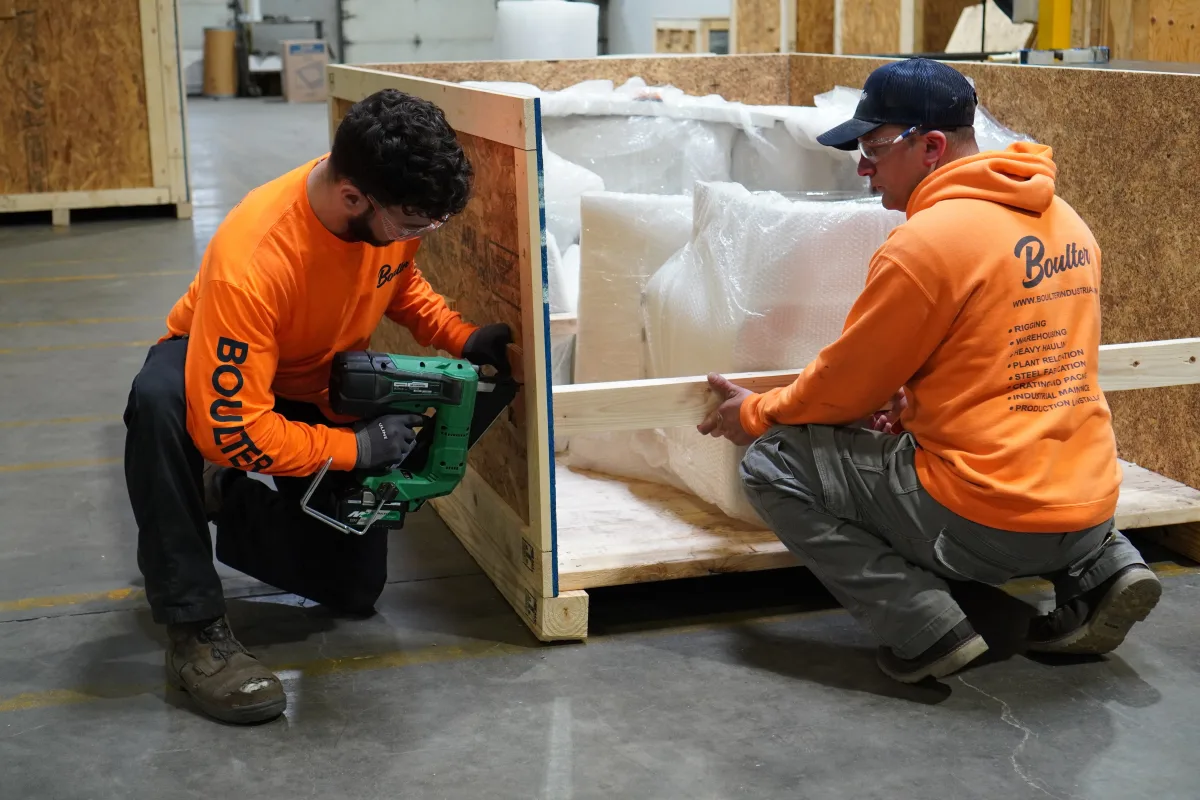
Step 1: Cargo Audit & Dimensions: Engineers record exact physical dimensions, center of gravity, delicate contact points, and shipping mode (air cargo, FCL, or LCL).
Step 2: Timber Selection & ISPM 15 Verification: Kiln-dried, certified heat-treated timber is sourced and verified against registered phytosanitary standards.
Step 3: Base Fabrication & Skid Engineering: A heavy-duty base pallet is constructed with chamfered timber runners to allow 4-way forklift access and crane sling clearance.
Step 4: Moisture Barrier & Internal Cushioning: Cargo is secured on timber saddles, cushioned with custom polyethylene foam, and sealed within a vacuum foil or VCI enclosure with desiccants.
Step 5: Enclosure, IPPC Stamping & Marking: Walls and roof panels are secured, steel perimeter bands are tensioned, and official IPPC wheat stamps and handling symbols are stenciled.
8. Frequently Asked Questions (FAQ)
What happens if a wooden crate lacks an ISPM 15 stamp?
Customs officials at destination ports will reject the cargo immediately. The container may be placed in quarantine, fumigated at astronomical penalty rates, or ordered to be re-exported or destroyed at the shipper's expense.
What is the difference between Heat Treatment (HT) and Methyl Bromide (MB)?
Heat Treatment (HT) heats the wood core to 56°C for 30 minutes in a kiln, leaving zero chemical residue. Methyl Bromide (MB) is a chemical fumigant that is toxic and heavily restricted or banned in many markets, including the European Union.
Are plywood boxes exempt from ISPM 15 regulations?
Yes. Processed engineered wood like plywood, OSB, and hardboard is created under high heat and pressure with adhesives, eliminating pests. Pure plywood cases without raw timber cleats are exempt from ISPM 15 treatment requirements.
Can an export-grade wooden crate be reused for subsequent shipments?
Yes, provided the crate is structurally sound and has not been repaired with untreated timber. If any solid replacement timber is added, the crate must be re-treated and re-stamped by an authorized facility.
9. Safeguard Your Global Cargo with Trivandrum’s Crating Specialists
Packaging failures should never be the cause of missed international project milestones, damaged equipment, or customs impoundment. Investing in compliant, custom-engineered wooden packing secures your bottom line and preserves your brand reputation.
Whether you are shipping heavy industrial tooling through Vizhinjam Port, dispatching critical electronics from Technopark, or coordinating an international commercial move, our Trivandrum-based industrial packing team is ready to assist.